

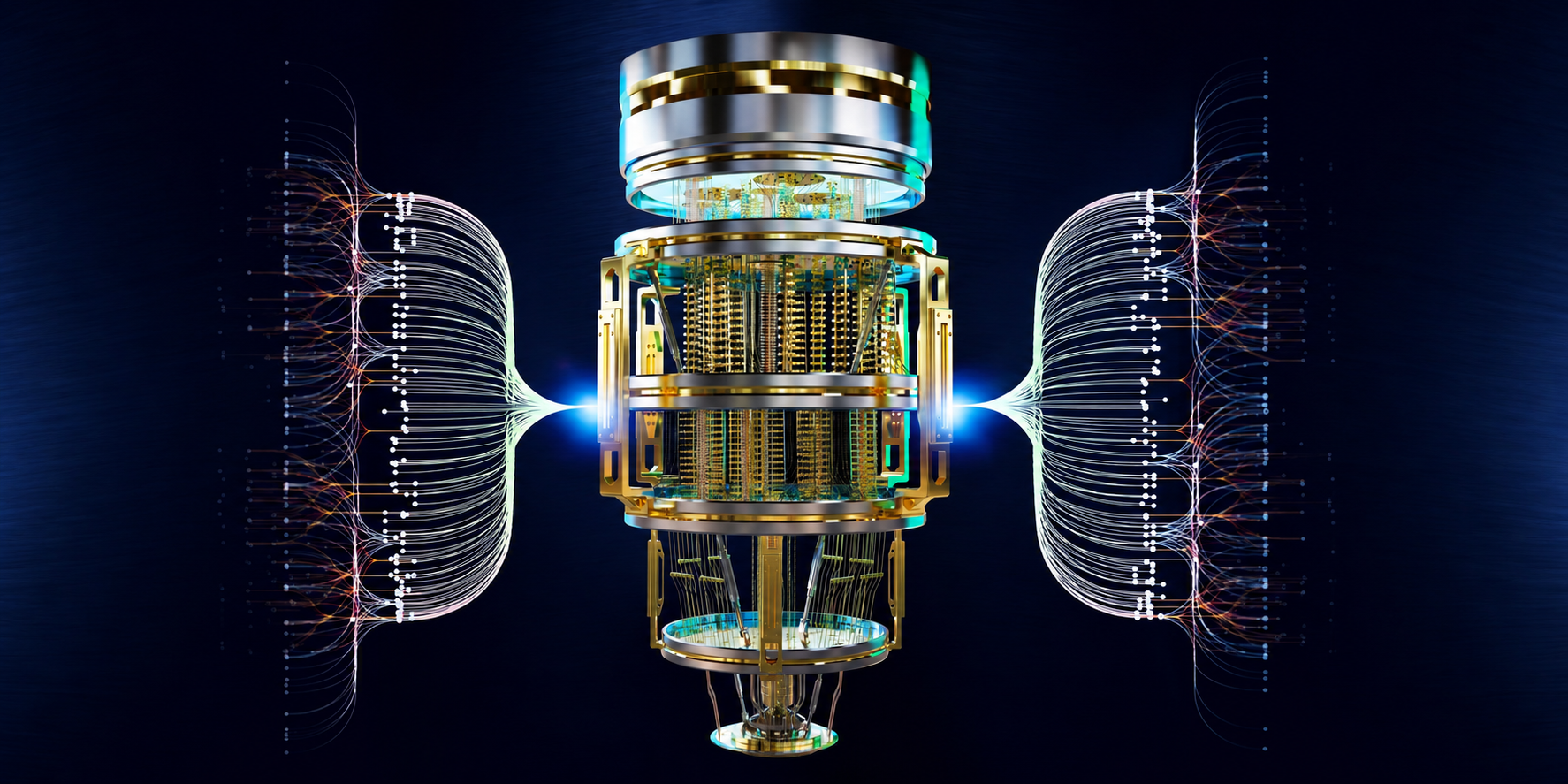
The AI boom rewarded those who moved early. Quantum computing may be setting up a similar window, and this time, Indian investors have more ways in than ever.
In December 2024, Google's 105-qubit Willow processor solved a benchmark problem in under five minutes. The same calculation would take a classical supercomputer roughly 1025 years, a number so large it dwarfs the age of the observable universe. That result, published in Nature and peer-reviewed, was not a marketing claim. It was the field's clearest signal yet that quantum computing has crossed from theoretical promise into engineering reality.
For investors who watched the AI wave from the sidelines in 2022 and 2023, quantum computing is raising a familiar question: Is this the moment to start paying attention?
What is Quantum Computing, and Why Does It Matter to Markets?
Classical computers work with bits, 0s, and 1s processed one at a time. Quantum computers use qubits, which exploit quantum mechanics to process enormous numbers of possibilities simultaneously. This does not make quantum computers faster at everything. But for specific categories of hard problems — drug discovery, portfolio optimization, cryptography, logistics, materials science — quantum machines could deliver results that classical hardware simply cannot.
The market opportunity follows from those use cases. McKinsey projects the quantum computing market could reach $198 billion by 2040. More near-term estimates put the global market at $20 billion by 2030, growing at over 40% annually. Venture capital funding crossed $2 billion in 2024, a 50% jump from the prior year. Commercial hardware sales hit $854 million in 2024, up 70% from 2023.
These are not speculative projections from enthusiasts. They are estimates from banks and consulting firms being used by institutional investors to allocate capital right now.
The 2024–2025 Inflection: What Changed
The quantum field has a history of over-promising. What makes the 2024–2025 period different is that the breakthroughs are measurable, reproducible, and showing up in corporate earnings conversations.
Error correction was quantum computing's oldest unsolved problem. Qubits are delicate; noise and interference cause errors that compound quickly. Google's Willow chip demonstrated, for the first time, that error rates fall exponentially as more qubits are added. IBM's Heron R2 processor, unveiled in late 2024, cut two-qubit gate errors to 8×10⁻⁴ and delivered a 50x speedup on certain workloads versus IBM's previous best. Microsoft introduced Majorana 1, a topological qubit chip it claims offers a path to a million qubits by making qubits inherently more stable.
Beyond hardware, real enterprises are extracting real value. HSBC used IBM's quantum computer to improve bond trading predictions by 34% over classical computing alone. Engineering firm Ansys ran a medical device simulation on IonQ's hardware that outpaced classical high-performance computing by 12%. Ford Otosan deployed D-Wave's quantum system in production, cutting scheduling time from 30 minutes to under five.
These are narrow wins, not general-purpose breakthroughs. But they mark the transition from lab demonstrations to the first line items on enterprise technology budgets.
The India Angle
India is not a bystander in this shift. It is an active participant, and that has direct implications for how Indian investors should think about the sector.
The Government of India's National Quantum Mission (NQM), approved by the Union Cabinet in April 2023, has committed ₹6,003.65 crore (approximately $730 million) in funding through 2031. The mission targets the development of quantum computers with 50 to 1,000 physical qubits, satellite-based quantum communication across 2,000 kilometres, and a network of four dedicated technology hubs. ISRO is developing quantum key distribution satellites as part of the program.
The strategic logic is straightforward: quantum computing will reshape cryptography, national security, and high-value R&D. A country that imports all of it will be strategically dependent. India has decided it cannot afford that.
At the corporate level, Indian IT majors are moving early. TCS, in partnership with IBM and the Andhra Pradesh government, is building India's largest quantum facility — the Quantum Valley Tech Park in Amaravati — with access to IBM quantum systems for enterprise clients. Larsen & Toubro, through its L&T-Cloudfiniti arm, has partnered with QpiAI to offer Quantum Computing as a Service (QCaaS) to Indian businesses. Tata Elxsi is applying quantum-assisted optimisation to automotive and healthcare engineering projects.
These are not moonshot bets for Indian blue chips — they are early-stage positioning moves that investors in TCS, L&T, and related names should be tracking in quarterly calls and annual reports.
How Indian Investors Can Get Exposure
The global quantum computing investment landscape has expanded considerably. Indian investors with access to international markets — through platforms like Groww, INDmoney, or brokers such as Interactive Brokers — have several credible routes.
Pure-play quantum stocks carry the highest risk and the highest potential reward. IonQ (NYSE: IONQ) is the sector's current revenue leader, projecting $75–95 million in 2025 revenue with a $1.6 billion cash position and partnerships with AWS and Microsoft Azure. Rigetti Computing (NASDAQ: RGTI) is an earlier-stage company with minimal revenue but a significant research footprint. D-Wave Quantum (NYSE: QBTS) already operates commercial quantum systems, with optimization use cases deployed in production across logistics and finance clients. These stocks are volatile, loss-making, and priced on future potential — position sizing matters more than conviction.
Large-cap exposure is available through companies with substantial, funded quantum programs running alongside profitable core businesses. Alphabet (Google's parent) and IBM are the most directly exposed. Microsoft's Majorana 1 architecture represents a significant architectural bet. For Indian investors familiar with US tech holdings, quantum exposure through these names comes with far more fundamental support than pure-plays.
ETFs offer the most accessible and diversified route. The Defiance Quantum ETF (QTUM), listed on Nasdaq with a 0.40% expense ratio, holds approximately 78 companies across quantum hardware, machine learning, and quantum-enabling semiconductors. It returned 76% over the 12 months through mid-2025. The iShares Quantum Computing and AI ETF (QANT), launched in December 2025 and backed by BlackRock, tracks the STOXX Global Quantum Computing Index — its top holdings include Alphabet (8.88%), IBM (8.16%), and Microsoft (7.35%). WisdomTree's WQTM, also launched in late 2025, provides concentrated exposure to pure-play names.
For Indian investors who prefer the domestic market, TCS and L&T offer indirect exposure with balance sheet support that pure-play quantum companies simply do not have. They are not quantum investments in the way IONQ is, but they are reasonable proxies for investors who want quantum participation within a portfolio that can handle Indian equity risk.
The Risk Investors Must Understand
NVIDIA CEO Jensen Huang said in January 2025 that practical quantum computing is 15 to 30 years away. He has been wrong on tech timelines before, but his point about current limitations is legitimate. Qubits are still fragile, error correction is still imperfect, and fault-tolerant systems capable of running commercially relevant workloads are years away. IBM's Starling processor, targeting 200 logical qubits with 100 million error-corrected operations, is not expected until 2029.
Most serious researchers believe that commercially dominant quantum advantage — the kind that reshapes pharma, finance, and materials science at scale — will arrive in the second half of the 2030s. The investment horizon here is a decade, not a year.
The risk of a prolonged "quantum winter" — where a technical bottleneck stalls progress and speculative valuations compress — is real. Several pure-play quantum stocks trade at valuations that price in futures that may not materialise on the schedules the market implies. Rigetti, for instance, trades at roughly 900x price-to-sales. D-Wave's annealing technology is commercially deployed but limited in scope relative to what gate-model quantum computers promise.
The NIST publication of post-quantum cryptography standards in August 2024 — formal recognition by a global standards body that quantum-capable encryption-breaking is a near enough threat to act on — is perhaps the clearest signal of the technology's trajectory. Governments and financial institutions are being told to start migrating their encryption infrastructure now, before the quantum threat arrives. That migration is a decade-long procurement cycle that has already begun.
The Parallel That Indian Investors Should Not Ignore
India's IT industry — TCS, Infosys, Wipro, HCL — was built on being early to a global computing shift that the West initiated, and India executed at scale. The service opportunities in quantum computing, from implementation to quantum-safe cybersecurity to algorithm development for enterprise clients, follow a recognisable pattern.
The National Quantum Mission is the government's effort to ensure that India is a developer of quantum technology, not just a deployer of someone else's. Whether it succeeds at that ambition will matter for the long-term strategic picture. In the near term, the services and integration opportunity is familiar territory for India's technology sector.
The quantum decade is beginning. The early innings belong to the risk-tolerant. The broader opportunity — in services, integration, and enterprise deployment — will belong to whoever is prepared when the technology matures.
Disclaimer: Investments in securities markets are subject to market risks. Read all related documents carefully before investing. The securities and examples mentioned above are only for illustration and are not recommendations.