

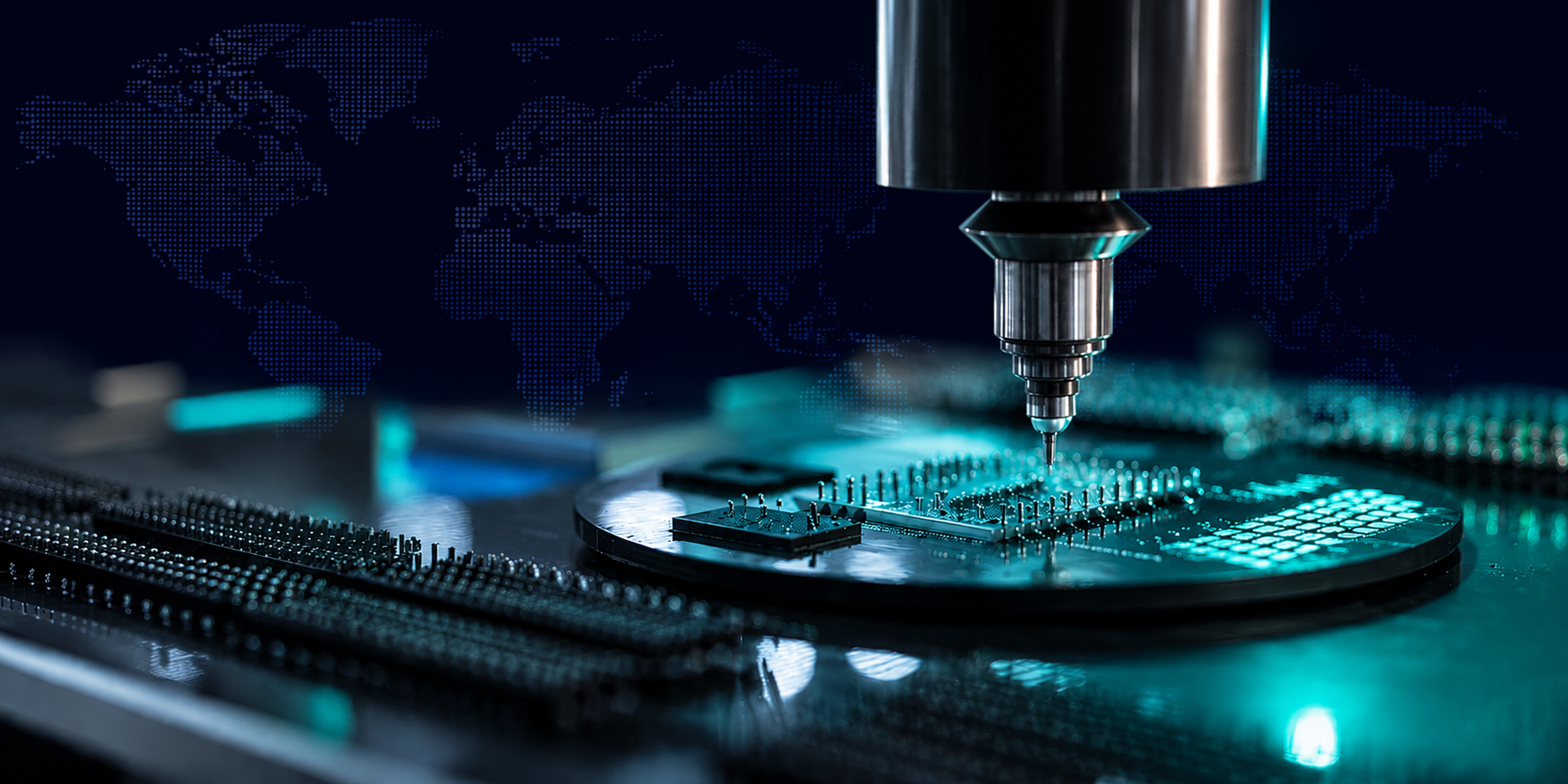
They are smaller than a human hair and more valuable than oil. The country that controls them controls the future. The United States has decided that country will be America, and it is writing very large cheques to make sure of it.
In 2021, a shortage of automotive chips — components that cost just a few dollars apiece — forced General Motors, Ford, and Toyota to idle factories worldwide, wiping tens of billions of rupees off their market values. The semiconductor that froze global auto production was not a cutting-edge AI accelerator. It was a legacy chip, the kind used in dashboards and fuel sensors, manufactured on decades-old processes. The lesson was brutal in its simplicity: without chips, nothing works. Not cars. Not phones. Not fighter jets. Not financial markets.
That episode made semiconductors front-page news for the first time. What it revealed was something engineers and supply chain strategists had known for years — that the global economy does not merely use semiconductors. It runs on them.
A $630 Billion Industry Growing Faster Than Almost Everything Else
The Semiconductor Industry Association reported that global semiconductor sales hit a record $627.6 billion in 2024, a 19.1% jump from 2023, the largest annual increase in years. The market is forecast to cross $697 billion in 2025 and approach $1 trillion by 2029. Over a longer horizon, projections put the industry at $1.5 trillion by 2034, growing at roughly 10% annually.
For context, these are revenues from selling the components that go into everything else. Semiconductors are not a finished product category — they are the foundational input to every significant technology sector in the world. Logic chips, the largest product category at $212.6 billion in 2024, power the CPUs and AI accelerators that run the global internet. Memory chips, the second-largest at $165.1 billion in 2024, store the data that enterprises, governments, and consumers depend on daily. Both categories grew at double-digit rates in 2024. Memory alone surged 78.9%.
Behind that surge is the AI buildout. Every large language model, every generative AI application, every cloud inference workload runs on semiconductors — specifically on high-end GPUs and high-bandwidth memory that only a handful of companies in the world can manufacture. NVIDIA's revenue crossed $100 billion in fiscal year 2025, driven almost entirely by demand for AI chips. That number was $27 billion just two years earlier. No industry in modern history has grown that quickly at that scale.
The Concentration Problem: Why One Island Controls Everything
Here is a fact that makes defence ministries and treasury secretaries lose sleep: Taiwan's TSMC produces over 90% of the world's most advanced semiconductor chips — those manufactured at 7 nanometers and below. In extreme ultraviolet lithography equipment, a machine without which advanced chips cannot be made, a single Dutch company, ASML, is the world's only supplier. In chip design software, three American firms — Synopsys, Cadence, and Siemens EDA — control more than 80% of the global market.
This level of concentration in a $630 billion industry that underpins every technology sector is without parallel in the modern global economy. The disruption of any single link — TSMC's fabs, ASML's lithography machines, or the chokepoints in chip design tools — would not merely cause a supply shock. It would shut down automobile production, defence manufacturing, data centre construction, and consumer electronics simultaneously, across every major economy.
Taiwan's semiconductor dominance has earned it the label of a "silicon shield" — the logic being that any military aggression against the island would devastate the attacker's own technology supply chains. It is a genuinely unusual form of strategic deterrence. But it is also a structural vulnerability for everyone else: a reminder that the most critical input to the global economy is concentrated in a 35,980 square kilometre island sitting in one of the world's most contested geopolitical flashpoints.
The Great Chip War: How Semiconductors Became a Geopolitical Weapon
The US-China technology rivalry is, at its core, a semiconductor rivalry. The United States recognised that advanced chips are the enabling layer for AI, hypersonic missiles, surveillance systems, and autonomous weapons — and that maintaining a lead in chip technology is equivalent to maintaining a lead in military and economic power.
Starting in October 2022 and tightening progressively through 2023, 2024, and into 2025, the US imposed sweeping export controls on advanced chips and chip-making equipment to China, building a multilateral coalition that includes the Netherlands (ASML), Japan, and South Korea. The controls have been expanded three times, each time closing new loopholes, from AI accelerators to high-bandwidth memory to the tools used to design and fabricate chips at advanced nodes.
China's response has been to throw state capital at the problem. Its "Big Fund" Phase III, launched in May 2024, channels hundreds of billions of yuan into domestic chip development. Chinese AI labs have responded with software innovations — DeepSeek's efficiency breakthrough wiped $600 billion from NVIDIA's market cap in a single day in January 2025 — but hardware self-sufficiency at the leading edge remains years away. TSMC, meanwhile, has begun expanding to Arizona ($165 billion committed, three new fabrication plants planned), Japan, and Europe, under pressure from both its customers and the governments of allied nations.
This fragmentation of what was once the world's most efficient globalised supply chain has direct investment consequences. Chip prices are rising. NVIDIA raised prices on AI GPUs by up to 15% following new US tariffs on imported components. TSMC is considering a 10% price increase on advanced wafers. The cost of building a semiconductor fab in the United States is roughly 30% higher than in Taiwan. These costs will flow through to every downstream industry that relies on semiconductors, which is every industry.
The India Moment: More Significant Than It Appears
India's semiconductor story is moving faster than most investors have noticed.
The India Semiconductor Mission (ISM), backed by ₹76,000 crore in production-linked incentives, has already approved six domestic semiconductor manufacturing facilities as of May 2025. The sixth, a joint venture between HCL and Foxconn, was cleared this year. Tata Electronics is building a chip assembly and testing plant in Gujarat. The broader "Semicon India" programme is attracting investments from global names that recognise India as the most credible alternative to Taiwan and China for trusted supply chain diversification.
India's structural advantages here are real and underappreciated. Approximately 20% of the world's chip engineers already work in India. The country has 110 mining engineering colleges producing a scalable talent pipeline. The US has explicitly identified India as a preferred strategic partner in semiconductor supply chain resilience — a position that carries significant implications for investment flows, technology transfer, and geopolitical alignment.
India will not manufacture the world's most advanced chips within this decade. TSMC's 2nm processes and ASML's EUV machines are not easily replicated. But India does not need to be at the frontier of chip fabrication to benefit. Chip packaging, assembly and testing, design services, and the manufacturing of mature-node semiconductors — the kind used in automobiles, industrial equipment, and consumer appliances — are commercially significant markets that are actively relocating out of concentrated geographies, and India is a serious contender.
For Indian investors, this matters in two ways. Domestically, companies like Tata Electronics, HCL, and India's growing semiconductor design ecosystem represent early-stage exposure to a structural multi-decade shift. Globally, the Indian IT sector's talent base in chip design — Qualcomm, Intel, AMD, and NVIDIA all run large engineering centres in India — is a competitive asset that will appreciate as the industry expands.
How Indian Investors Can Access the Semiconductor Theme Globally
The clearest global exposure is through the companies that dominate the chip value chain. TSMC (NYSE: TSM) is the world's dominant foundry and one of the most strategically irreplaceable companies on earth. NVIDIA (NASDAQ: NVDA) has become the defining company of the AI chip era, with revenue growing at a pace that makes the semiconductor market's overall growth look modest. ASML (NASDAQ: ASML) holds a global monopoly on EUV lithography, the tool without which no advanced chip can be made.
For broader, diversified exposure, ETFs are the most accessible route. The VanEck Semiconductor ETF (SMH) holds the top 25 semiconductor companies globally, with a 0.35% expense ratio. The iShares Semiconductor ETF (SOXX) offers comparable diversified exposure across chip designers, manufacturers, and equipment makers. Both are accessible through international investment platforms available to Indian residents, including INDmoney, Groww, and Interactive Brokers.
Indian investors considering global semiconductor stocks should be clear-eyed about the risks. The industry is cyclical — it posted a 9.4% decline in 2023 before recovering 19% in 2024. Chip stocks can be volatile even within bull markets: NVIDIA's DeepSeek shock demonstrated how rapidly sentiment can swing on technology disruption news. Geopolitical escalation around Taiwan remains the sector's most significant tail risk, one with no clean hedge.
The Structural Case, Plainly Stated
Semiconductors are not a sector. They are infrastructure. Every transformative technology trend of the next two decades — artificial intelligence, electric vehicles, autonomous systems, quantum computing, 5G and 6G networks — is a chip demand story. The industry's revenue grew from $139 billion in 2001 to $630 billion in 2024, a compound annual growth rate of 6.8% sustained over more than two decades through multiple recessions, a global pandemic, and two technology bubbles.
The difference today is that semiconductors have moved from being a technology input to a national security asset. Governments are spending at a scale not seen since the space race to secure domestic chip supply chains. The CHIPS and Science Act in the US, the European Chips Act, India's ISM, and Japan's own semiconductor incentive programmes collectively represent hundreds of billions of dollars in state-directed investment flowing into this industry over the next decade.
That combination — structural demand from AI and electrification, geopolitical-driven supply chain investment, and India's specific positioning as a trusted manufacturing and design alternative — makes semiconductors one of the most consequential investment themes of this decade for any globally minded Indian investor.
The chip is not glamorous. It is not a brand or a platform or an experience. It is a piece of crystallised silicon the size of a thumbnail. But it runs the world. And the world is only just beginning to understand what that means.
Disclaimer: Investments in securities markets are subject to market risks. Read all related documents carefully before investing. The securities and examples mentioned above are only for illustration and are not recommendations.