

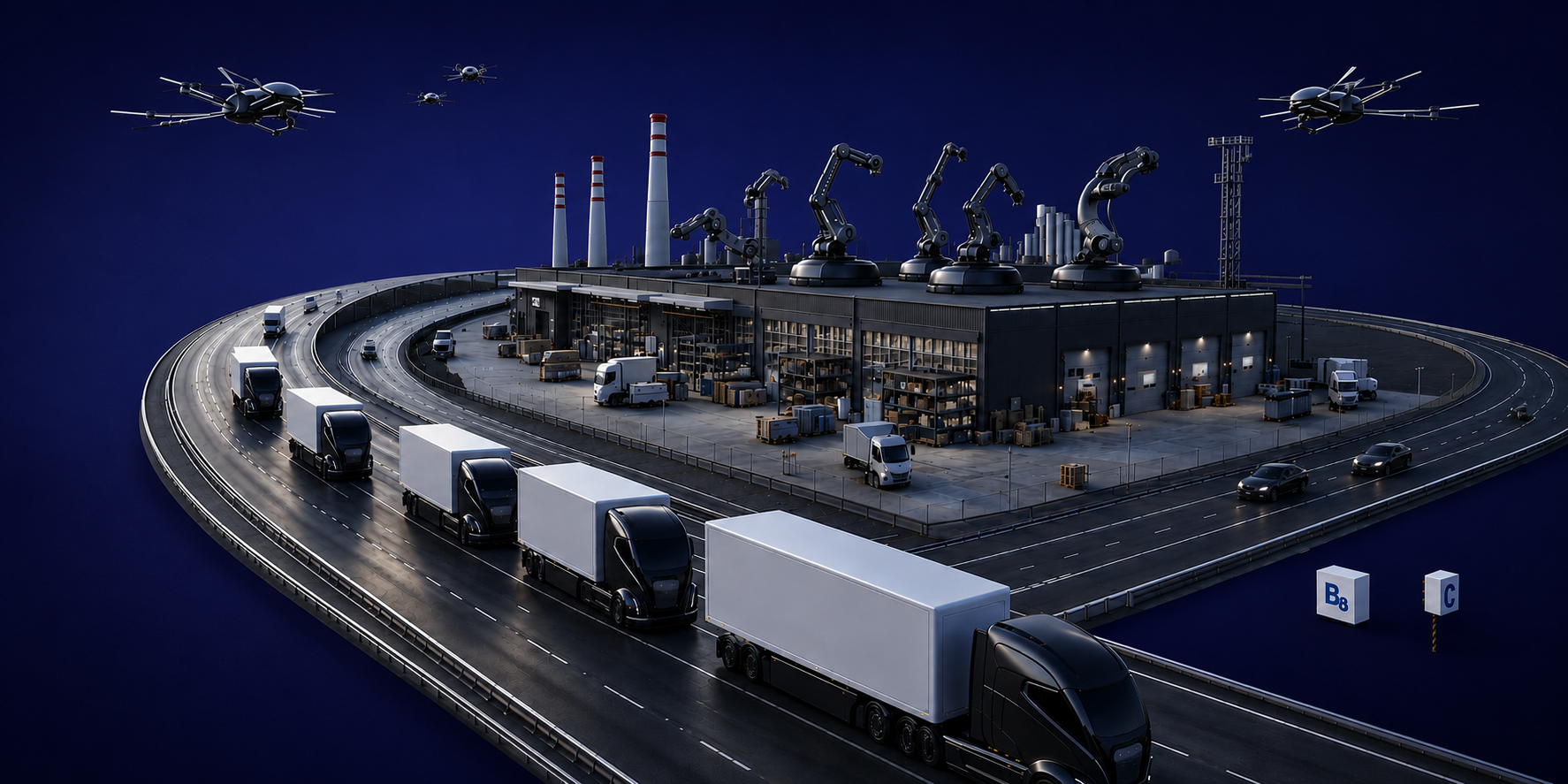
On May 1, 2025, a self-driving truck completed a 240-mile route from Dallas to Houston fully driverless — no human on board — hauling commercial freight for real customers at commercial rates. It was not a test. It was a Tuesday.
Aurora Innovation, a Pittsburgh-based autonomous driving company, made history that week by becoming the first company to operate a commercial Level 4 autonomous trucking service on public US roads. Its customers were Uber Freight and Hirschbach Motor Lines. By the end of June, Aurora had surpassed 250,000 driverless miles with nearly 100% on-time delivery. The age of autonomous freight is not arriving. It has arrived, in a specific corridor, at a limited scale, with enormous implications for what comes next.
For Indian investors tracking global technology megatrends, autonomous vehicles in logistics represent one of the most consequential and least fully appreciated investment themes of the coming decade.
The Problem Autonomous Trucks Are Built to Solve
The global trucking industry carries the world's goods. In the United States alone, it is a $719 billion market. In India, road freight accounts for roughly 65% of total freight movement. The economics of trucking have always rested on one expensive, unreliable, and increasingly scarce input: the human driver.
The US faces a shortage of over 80,000 truck drivers today, with projections suggesting that gap could exceed 160,000 by 2031. Driver compensation averages $60,000–$80,000 per year in the US, and turnover costs run $8,000–$12,000 per new hire — in an industry where annual churn regularly exceeds 90% at large carriers. Hours-of-service regulations limit US drivers to 11 hours of driving per 24-hour period. An autonomous truck has no such limit. It does not sleep, take breaks, file complaints, or require benefits.
Bernstein analysts estimated that full automation of the US trucking market could yield approximately $300 billion in labour savings. Even partial automation — applied to long-haul, highway-heavy routes where the technology works best today — could reduce costs by 30%, generating roughly $168 billion in annual savings for the freight industry. These are not speculative figures from AI enthusiasts. They are analyst estimates being used to size market opportunity by institutional investors right now.
The Technology Has Crossed a Critical Threshold
For years, autonomous vehicle timelines slipped. Each promised commercial launch was followed by delays, scaling back, or company failures. That cycle appears to have broken in the last 12 months — not because everything is solved, but because specific, bounded use cases are now working reliably.
Long-haul highway trucking is the ideal environment for Level 4 autonomy: predictable roads, minimal pedestrians, structured lanes, and limited edge cases compared to urban driving. Aurora has launched commercially on the Dallas-Houston corridor and is expanding to El Paso and Phoenix by end-2025. Kodiak Robotics completed the first fully driverless commercial freight delivery in the US in December 2024, operating for Atlas Energy Solutions on private lease roads in West Texas. Bot Auto, a newer entrant, completed a 230-mile fully humanless freight run from Houston to Dallas on public roads in 2025, validated commercially for Ryan Transportation, a real logistics client.
The technology stack powering these deployments — LiDAR sensors now capable of detection beyond 500 yards, AI-integrated cameras that recognise road conditions in real time, NVIDIA's DRIVE Thor computing platform embedded in Aurora's systems — has matured to the point where hardware partners are planning mass production. Continental, the tier-one automotive supplier, is scheduled to begin mass production of Aurora's autonomous hardware kit by 2027.
Aurora's partnerships span FedEx, Schneider, Werner, and DHL, in addition to Uber Freight. These are not pilots. They are commercial operations with freight revenue, and the companies involved are publicly listed enterprises with fiduciary obligations to shareholders.
Last-Mile Delivery: The Other Revolution
Long-haul autonomous trucking addresses freight between cities. Last-mile delivery — the final leg from distribution centre to front door — is a separate and equally large problem. It is also the most expensive segment of the supply chain, accounting for 53% of total shipping costs according to industry estimates, precisely because it requires dense human labour in unpredictable urban environments.
The autonomous last-mile market was valued at approximately $21.5 billion in 2024 and is projected to reach $228 billion by 2035, growing at a compound annual rate of over 23%. The technology here is more diverse: sidewalk delivery robots (Starship Technologies, Cartken), autonomous delivery vans (Nuro, which is partnered with Walmart), and aerial drones (Wing Aviation, the Alphabet subsidiary, which has conducted over one million commercial deliveries across the US, Australia, and Finland).
Amazon's delivery drone programme, Prime Air, received FAA approval for expanded commercial operations in 2024. Cainiao, Alibaba's logistics arm, launched its Level 4 autonomous delivery vans on Chinese public roads in September 2024. JD.com and Meituan have deployed autonomous delivery robots at meaningful scale across Chinese cities, with estimates of over 200,000 autonomous delivery units operating in China by 2025.
The economics are compelling at scale. Studies of autonomous delivery suggest cost reductions of 40–60% versus human-operated delivery at full deployment, driven by labour elimination, route optimisation, and 24/7 operational availability.
The Numbers Behind the Shift
The autonomous freight and logistics market reached approximately $53 billion in 2024 and is expected to hit $185 billion by 2032, growing at nearly 17% annually. The autonomous truck market alone is projected to expand from $47 billion in 2025 to $185 billion by 2035. The broader autonomous vehicles in logistics market — encompassing trucks, last-mile robots, drones, and port automation — is estimated at $55 billion in 2025 and forecast to reach $650 billion by 2033 at a 35% compound annual growth rate.
For context, Indian logistics — a sector currently valued at over $215 billion domestically and growing at 10–12% annually — will not be insulated from this shift. India's freight networks are predominantly road-based, the driver shortage is structural and worsening, and the country's rapidly expanding e-commerce sector generates last-mile delivery demand at a scale that human labour alone will struggle to serve.
The India Dimension: Lagging but Not Absent
India's regulatory environment for autonomous vehicles is nascent. The Motor Vehicles Act has not yet created a formal framework for driverless commercial operation. In contrast, Texas and Arizona have been actively welcoming commercial autonomous freight since 2021, which is precisely why Aurora, Kodiak, and others launched there first.
But the Indian opportunity in autonomous logistics is not primarily about deploying self-driving trucks on NH-48 next year. It is about the technology stack that makes these vehicles work — and India's outsized role in building that stack.
NVIDIA, whose DRIVE platform powers most commercial autonomous systems deployed today, runs one of its largest global engineering centres in Pune and Hyderabad. Qualcomm, whose Snapdragon Ride chips are embedded in autonomous vehicle platforms worldwide, has deep engineering roots in Hyderabad and Bangalore. Bosch India, Aptiv, and Continental — three of the largest automotive technology suppliers directly involved in autonomous vehicle hardware — all have substantial development operations in India. Mobileye, which provides the camera and AI systems used in advanced driver assistance systems globally, works with Indian software partners for algorithm development.
India's IT services sector — the engine of companies like TCS, Infosys, Wipro, and HCL — is already engaged in automotive software services, a segment that blends traditional software development with domain expertise in embedded systems, AI, and vehicle-to-everything (V2X) communication. As the autonomous vehicle industry scales, the demand for software development, testing, simulation, and validation will grow enormously, and much of that work will flow to India.
How Indian Investors Can Position for This Theme
The clearest global exposure is through the companies building the enabling technology layer. NVIDIA (NASDAQ: NVDA) is the dominant computing platform for autonomous vehicle systems — its DRIVE Thor chip is embedded in Aurora's driverless trucks, and the company's data centre AI chips are used to train every major autonomous driving model. Aurora Innovation (NASDAQ: AUR) is the first commercial operator of driverless freight in the US, with $1.2 billion in cash reserves and a roster of marquee logistics customers. Alphabet (NASDAQ: GOOGL) owns Waymo, which continues to expand both robotaxi and freight operations, and Wing, which is the most commercially advanced drone delivery operator in the world.
For broader diversified exposure, ETFs offer the most accessible route. The ARK Autonomous Technology & Robotics ETF (ARKQ) returned 74% over the 12 months through mid-2025 and has an annualised average return of 22% over the past decade, with holdings across autonomous vehicle developers, robotics, and AI infrastructure. The Global X Autonomous & Electric Vehicles ETF (DRIV) provides exposure across the full autonomous and electrified vehicle value chain, including semiconductor providers, sensor makers, and fleet operators.
Domestically, Tata Motors — through its commercial vehicle division and its investment in Jaguar Land Rover's autonomous vehicle research — has indirect exposure to the technology shift. Maruti Suzuki's parent Suzuki Motor has partnerships with Toyota and Subaru that include shared autonomous driving research. Infosys and Wipro both have growing automotive software services divisions that will benefit as autonomous systems create demand for testing, simulation, and integration services at global scale.
The Risks Are Real
Autonomous vehicle timelines have disappointed investors before. TuSimple, once a high-profile autonomous trucking pioneer, imploded amid governance failures and was delisted. Argo AI, backed by Ford and Volkswagen, was shut down in 2022. The capital intensity of AV development is severe, and companies without clear paths to profitability face existential risk if market conditions tighten.
Regulatory fragmentation remains a genuine constraint. Rules differ by state in the US, by country globally, and the absence of harmonised international standards will slow the pace at which commercial deployments scale. Liability frameworks — who is responsible when a driverless truck causes an accident — remain legally unresolved in most jurisdictions.
Labour displacement concerns will generate political resistance. The US has approximately 3.5 million truck drivers. Their unions and associations are already engaged in advocacy against autonomous deployment. In India, where commercial drivers number in the tens of millions and represent a politically significant constituency, regulatory approval for large-scale autonomous freight is likely to be a slow, contentious process.
These headwinds are real. They are not fatal. The economics of autonomous freight are too compelling, the labour shortages too structural, and the technological progress too consistent for the transition not to happen. The question, as always, is timing — and investors who understand both the opportunity and the constraints are better positioned than those who do not.
The truck left Dallas on a Tuesday morning with freight in its trailer and no one behind the wheel. That is the starting point, not the destination.
Disclaimer: Investments in securities markets are subject to market risks. Read all related documents carefully before investing. The securities and examples mentioned above are only for illustration and are not recommendations.